

In 1968, The Viet Cong Tracked A 5-Man Australian SAS Patrol. It Was A Fatal Mistake.
It was March 18th, 1968.
10 past 11:00 in the evening at the Hat Dich Jungle in Northwest Phuoc Tuy Province.
A lone headlight pierces the darkness.
A tractor pulling a trailer loaded with supplies rumbles down a wide jungle track the Americans had carved through the bush months earlier.
100 m ahead, five Australian soldiers lie completely still in a bomb crater.
Their fingers rest on a single firing wire buried beneath the trail.
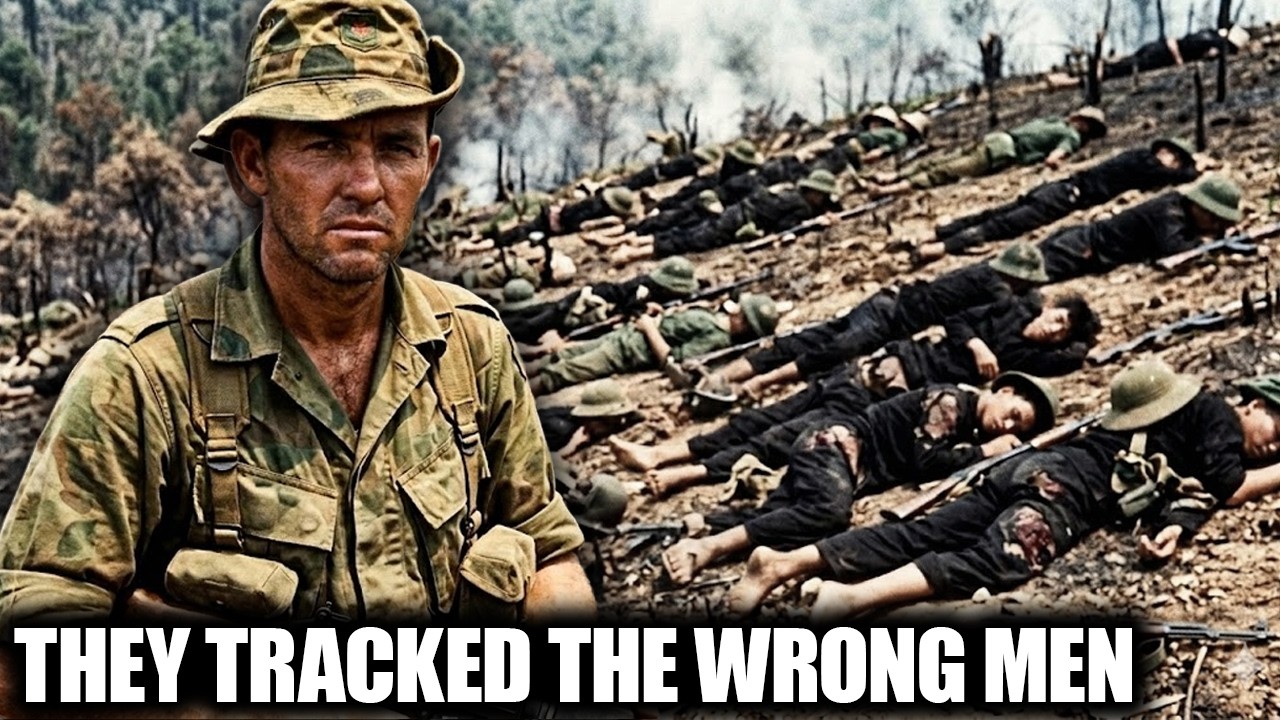
Four beehive-shaped charges and four claymore mines all wired to a pressure plate.
The driver believes this route is safe.
The Australians had pulled back from this area weeks ago.
That assumption is about to become fatal.
But to understand how five men turned the hunters into prey, we need to go back to the beginning.
February 1968.
While American attention fixated on the Tet Offensive, 2 Squadron of Australia’s Special Air Service Regiment quietly landed at Nui Dat.
They weren’t there to hold ground.
They weren’t there to win hearts and minds.
They were there to hunt.
These weren’t regular infantry.
The SAS selection process was brutal.
Only about 20% passed.
Those who made it became what the Viet Cong would call Ma Rung, phantoms of the jungle.
Their commander, Major Brian Wade, had studied demolition ambush tactics at Fort Bragg.
He’d arrived in Vietnam with explicit orders from Brigadier Ron Hughes, “Stop gathering intelligence and start killing.”
Hughes didn’t want reconnaissance reports, he wanted the 274th Viet Cong regiment to understand that Phuoc Tuy province was no longer safe.
The math was insane.
Five to six men per patrol against enemy forces that operated in companies of 100 or more.
But the SAS had something the VC didn’t expect.
They turned the jungle itself into a weapon.
March 17th, 1968 A RAAF number 9 Squadron Iroquois lifts off from Nui Dat carrying six men.
The patrol commander, Sergeant Frank Cashmore, 25 years old from Collie, Western Australia.
This was his first patrol as commander.
His second in command, Corporal Danny Wright, 28, Vietnamese language qualified, lead demolitions expert.
Corporal Dave Sheil, 28, ex-Dutch commando, demolitions assistant.
Private Kim McAuley, 19, first operational tour, west flank security.
Private Adrian Blacker, 21, carried a silent Sterling SMG, east flank security.
Private David Elliott, 22, demolitions.
He’d carry the heaviest load of his life.
Their target, the Firestone Trail, a wide track about 200 m west of landing zone Dampier, carved by American Rome plows through the Hat Dich jungle.
An observation flight had spotted something unusual.
Fresh tractor tracks crossing the LZ.
No allied vehicle had authorization to be there.
Intelligence estimated up to 60 VC escorting the vehicle.
Each man carried 14 water bottles, 7 days of rations, weapons, demolitions, a URC-10 radio.
The total weight was crushing.
The helicopter flared for landing.
The men jumped.
Elliott went down immediately.
The weight of his demolition pack drove him into the ground.
His leg gave out.
Within minutes, the helicopter came back to extract him.
They were down to five.
The ambush would have to work with what they had.
Cashmore had rehearsed this for 3 days at Nui Dat.
Major Wade himself had driven a Land Rover over the test set up to calibrate the pressure plate.
It had to be sensitive enough to trigger under a tractor tire, but not so sensitive that it would blow from wind or animals.
The beehive charge was designed to punch through armor.
Four of them buried beneath the trail surface wired in parallel.
Four Claymore mines positioned at angles to catch anyone flanking the vehicle.
Each Claymore contains 700 steel ball bearings.
One wire running 100 m to their firing position in a bomb crater.
A steel pressure plate calibrated to close the circuit only under the weight of a vehicle.
How are you going to operate to achieve that objective?
Um in a similar manner to uh what they had in Borneo in the way that there would be five man pro patrols which would be um in a variety of tasks like reconnaissance or or search and destroy or or those sorts of things.
Cordon and search was another method that was used as well.
You got 2 days off beforehand and that 2 days was spent collecting ammunition, servicing your rifle, making sure that everything fitted, drawing your rations, drawing making sure you had your food that you wanted and you know ditching stuff that you didn’t want, all your gear, your ammunition, hand grenades.
If there was a specific task, you You need white phosphorus or CS gas or something like that.
You have to rig You know, you dig tape like your colored smoke and all that sort of thing that you use for extraction or signaling to people if you run into strife.
And those sorts of things, yeah.
We were operating in a different way.
We never walked on tracks.
We never used a track.
If we came to a track, we would sit down for something like 20 minutes before and after crossing it to hear if anyone had seen us or anyone was following up.
Just to to move away and just move away far enough so that they couldn’t see us.
But we never used a track as a as a movement because they could come up from behind you or come around the corner and there’s 50 blokes here on the track and you’re suddenly all all you know, there’s a big pile of people going bang bang bang.
So, we would approach a track with caution.
We’d sit and watch it, listen out.
One would go up and then look up and down the track or we would approach it as a five in line abreast.
And then we would all cross.
Night fell.
The jungle came alive with sounds, insects, animals.
The patrol stayed completely still.
At 1:45 a.m., Cashmore heard it.
The low rumble of an engine.
A single headlight appeared from the east.
The tractor rolled over the pressure plate.
Nothing.
The circuit didn’t close.
The vehicle was too light or the plate hadn’t seated properly.
The VC supply run continued unmolested.
At first light, the patrol crept forward.
They reset the charges, recalibrated the plate, then disappeared back into their position.
The second night, 11:10 p.m. The single headlight appeared again.
Same tractor, same route coming from the west this time.
The Viet Cong driver had no idea he was driving over a firing plate.
No idea five Australians were watching through the darkness.
No idea this section of trail had been turned into a kill zone.
The tractor’s front tire rolled onto the plate.
It was the most horrific explosion I have ever witnessed in my military career.
It blew me arse over head backwards.
Four giant orange flames went up into the sky plus four claymores.
It was just unbelievable.
Four beehive charges detonated simultaneously.
The shaped charges turned the tractor into shrapnel.
The claymores shredded everything in a 50 m radius.
Four Vietnamese voices, right the language specialist understood at least one of them calling for help.
The patrol went to ground.
20 m back into the tree line, weapons ready.
At first light a lone VC survivor bandaged and bleeding staggered across landing zone Dampier.
The patrol stayed hidden.
No contact.
At 9:10 a.m. the Iroquois returned.
Five men climbed aboard, not a single combat casualty.
Air reconnaissance photographed the site.
The crater was massive.
The tractor and trailer were completely destroyed.
Official credit, 15 Viet Cong killed.
But a VC defector who later came over to the Allied side put the real number at 21.
Frank Cashmore would be known in the regiment for the rest of his career as Frank the tractor job Cashmore.
He returned for a second tour in 1971, but the real significance wasn’t the body count, it was the message.
The tractor job became the founding case study for what Major Wade called the wrecky ambush doctrine.
From April 1968 forward, two squadron stopped being an intelligence gathering unit.
They became a hunter-killer force.
Over six years of operations in Vietnam, the Australian SAS would conduct roughly 1,200 patrols.
They inflicted 492 confirmed Viet Cong killed against only two combat deaths of their own.
The Viet Cong called them Ma Rung, phantoms of the jungle, because five-man patrols had learned to routinely turn the hunters into the hunted.
The tractor job proved what Brigadier Hughes believed, that the SAS wasn’t meant to observe and report.
They were meant to make the enemy afraid to move at night.
And on that trail in March 1968, they succeeded.
The Australian SAS would remain in Vietnam until 1971.
By then, the strategic situation had shifted.
But the tactical lessons from patrols like Cash Moore’s would be studied at Fort Bragg, Hereford, and special operations schools around the world.
Five men, four beehives, four claymores, one wire, and one fatal assumption by the enemy that the trail was safe.